 Bahasa Indonesia
 English
A Comprehensive Look at Item Response Theory in Educational Research
Primary tabs
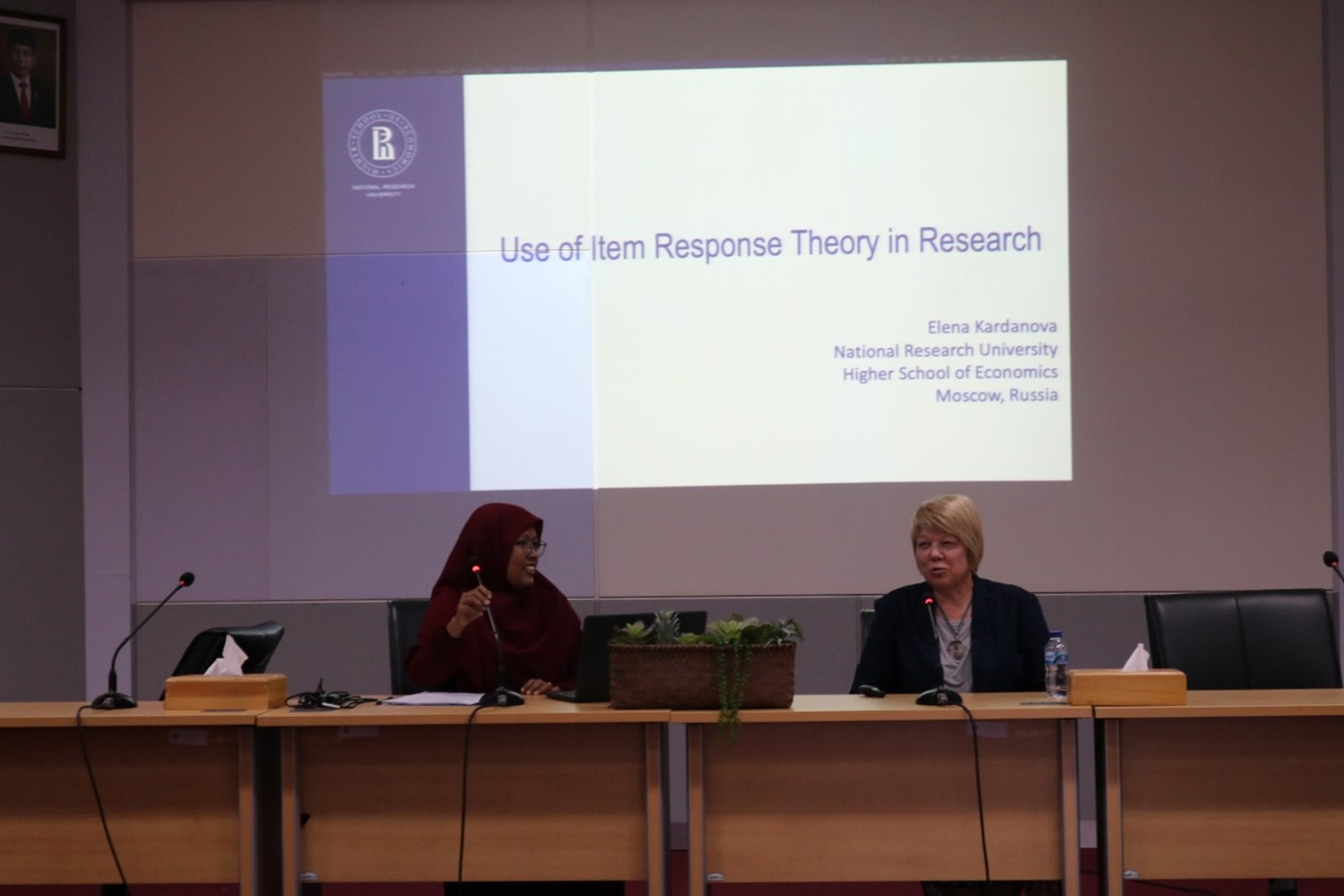
The Educational Research and Evaluation (ERE) Study program, Graduate School, Universitas Negeri Yogyakarta, held a public lecture as part of a series of visiting professor events. The public lecture was attended by master and doctoral students from the ERE study program, featuring Prof. Dr. Elena Kardanova from the Center of Psychometrics and Educational Measurement, Institute of Education, HSE University (National Research University Higher School of Economics, Moscow, Russia).
In this 100-minute public lecture, Elena presented a topic on “The Use of Item Response Theory (IRT) in Research.” The event was hosted by a doctoral student from the ERE study program at GS UNY.
Elena began the lecture by explaining the differences between classical test theory and modern test theory, as well as trends in both measurement theories. She introduced Rasch modeling and IRT models, as well as how IRT can be applied to item and scale analysis, investigating student learning progress, detecting rater effects, and the use of IRT in Computer Adaptive Testing (CAT).
She also shared various studies she has conducted related to the use of IRT, particularly in the Russian context. Elena emphasized that current trends in modern educational measurement focus on measuring student learning progress, 21st-century complex skills, the integration of technology in assessment, and improving the quality of measurement instruments through IRT. According to her, IRT has advantages over classical test theory, such as test-independent test taker ability parameters and sample-independent item parameters.
During the session, Elena discussed in detail the modern test theory paradigm of Rasch modeling, both for dichotomous and polytomous items. This discussion covered various Rasch models for polytomous items, such as the Partial Credit Model (PCM) and Graded Response Model (GRM), including the Rating Scale Model (RSM). Many-Facet Rasch Measurement (MFRM) was also explained, which allows test developers to ensure consistency among raters in assigning scores or grades.
At the end of the lecture, Elena reviewed the use of IRT in developing CAT. According to her, CAT development requires a process starting from the development of calibrated test items, determining the starting rules, selecting test items, scoring rules, to when the test ends.
Elena concluded the lecture by emphasizing the advantages and challenges of using IRT. The advantages of IRT include providing evidence of the validity of measurement instruments, estimating item and test characteristics, estimating test takers' abilities, and developing adaptive tests. However, the challenges faced include the higher complexity of IRT models, the need for larger sample sizes, and the interpretation of analysis results that are not easily understood by everyone, including teachers. This public lecture provided in-depth and comprehensive insights into IRT, while enriching the knowledge of the ERE study program of GS UNY students in educational research.